
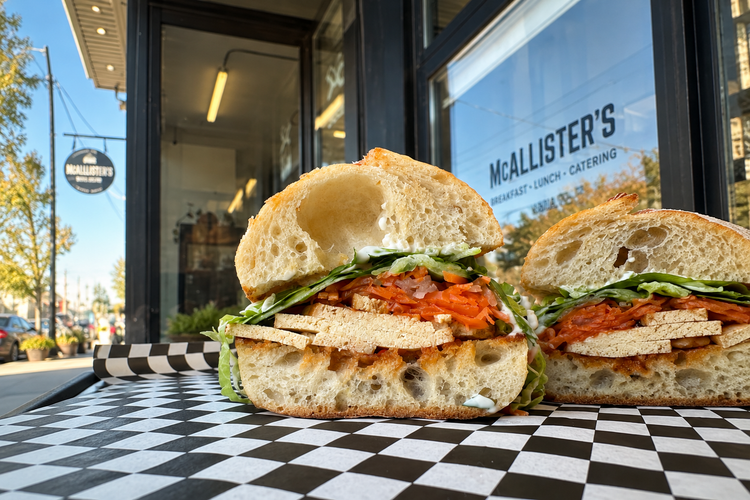
When Kevin Evelegh opened McCallister's in Hamilton, he needed a simple way to manage orders, food costs and staffing. With Clover, he gained the insights to reduce waste, streamline operations and prepare for future growth.
On a busy morning at McCallister's sandwich shop in Hamilton, Ont., Canada customers line up before the fresh-baked bread has even finished cooling. Teachers stop in for a couple dozen "Revivers," the restaurant's signature breakfast sandwich, before an early staff meeting. By noon, hungry healthcare staff drift over from Hamilton General Hospital across the street, seeking out the shop's most popular menu item, a fried chicken sandwich. It's all part of the friendly atmosphere at the neighbourhood spot named after Kevin McCallister, the main character in Home Alone.
On a typical day like this, owner Kevin Evelegh and his small team of five employees put together 100 to 150 handmade sandwiches. There's little room for error. Preparing too much means losing money on ingredients that go to waste, while making too little means missed sales and disappointed customers. Evelegh opened McCallister's in January 2026, and for a new restaurant operating on tight margins, either can put the business at risk.
To build a manageable operation, he needed a simple way to keep orders moving, understand what was selling and stay on top of food and labour costs.
The Clover solution
Before opening the business, Evelegh began looking for a POS system that could handle the speed of counter service without the added complexity of software built for a full-service restaurant. He also wanted something affordable, easy for staff to learn and flexible enough to support the business as it evolved.
After a friend recommended Clover, Evelegh signed up for its Counter Service Plan on a Station Duo. Designed for quick-service restaurants, the plan brings ordering and menu management, payments, inventory tracking, employee hours and business reporting together into one integrated system.
Importantly, ordering at McCallister's happens face-to-face, with staff entering items into the Station Duo. They can choose from simple categories for sandwiches, salads and sides. As the order is built, the customer is able to follow along on the screen in front of them and check that everything is right before they pay
The terminal takes every kind of payment, keeping the exchange quick without losing the personal feel of the counter. "We can take an order every 30 seconds," Evelegh says.
Protecting the bottom line
Behind the scenes, Evelegh uses Clover's sales reports to track what's selling, refine how much he prepares and keep food and labour costs in check.
Early on, for example, the shop offered a wide variety of sandwiches. Sales data showed that the Chay, a tofu banh mi, was among the slower sellers, allowing Evelegh to adjust his ordering and save an estimated $300 a month in food waste. The Reviver's popularity proved to be a different story, at one point reaching 48 sales a day.
By tracking demand, Evelegh is able to stock enough ingredients while also keeping the food waste per sandwich below two per cent. He took a similar approach with the shop's prepackaged salads, reducing waste to less than five per cent, down from as much as 40 per cent.
Evelegh now bases daily preparation on sales from the same day of the previous week, with a small buffer for fluctuations. Some items may sell out, but others pick up the slack. He estimates the approach saves at least $2,000 a month in food that might otherwise have been overprepared and thrown away.
Managing staff and mobile sales
As central as sandwich-making is to his business, Evelegh says that properly managing staff is equally important.
Employees can clock in, clock out and record breaks, while daily reports allow him to compare labour costs with sales. He uses the Homebase app to adjust shifts as demand changes, ultimately resulting in as much as 10 per cent savings, he says.
That flexibility, he notes, is "one of the top Clover features, for sure."
For mobile deliveries, including hospital runs and corporate catering, Evelegh saves the order in Clover and retrieves it through the Clover Go app on his phone. Customers can pay on the spot, and the transaction is recorded with the shop's other sales. "We don't have to deal with invoices and trying to get people to pay two weeks later," he says. "It makes it more seamless."
Room to grow
As McCallister's approaches its first anniversary and settles into a more sustainable rhythm, Evelegh is refining how he uses Clover. The clearer picture it provides of food and labour costs is "going to make our next quarter a lot more efficient," he notes.
His next steps include integrating Uber Eats with Clover, adding another printer in the kitchen and expanding the menu with more ready-to-go items. He has his sights set on expansion, too. "If after the first year we have some good numbers and we've got the process streamlined, I'd love to try it again in another location," he says.
For now, Clover is helping him build the process to support his ambitions. "Clover provides me all the data that I need to make good business decisions."
How can we help?
If you want to learn more about how Clover can help you accept payments, run your business and sell more, please contact your Clover Business Consultant. You can also follow us on Facebook and Instagram.